
The world of sports production is evolving at a rapid pace, driven by advances in remote technology and the rise of PTZ (pan-tilt-zoom) cameras. Once reserved for high-budget broadcasts, professional-grade sports production is now accessible to organizations of all sizes, from high schools to major universities and professional sports teams. As the demand for live streaming and multi-camera broadcasts grows, PTZ cameras and remote production solutions are becoming essential tools in the future of sports broadcasting.
The Rise of PTZ Cameras in Sports Production
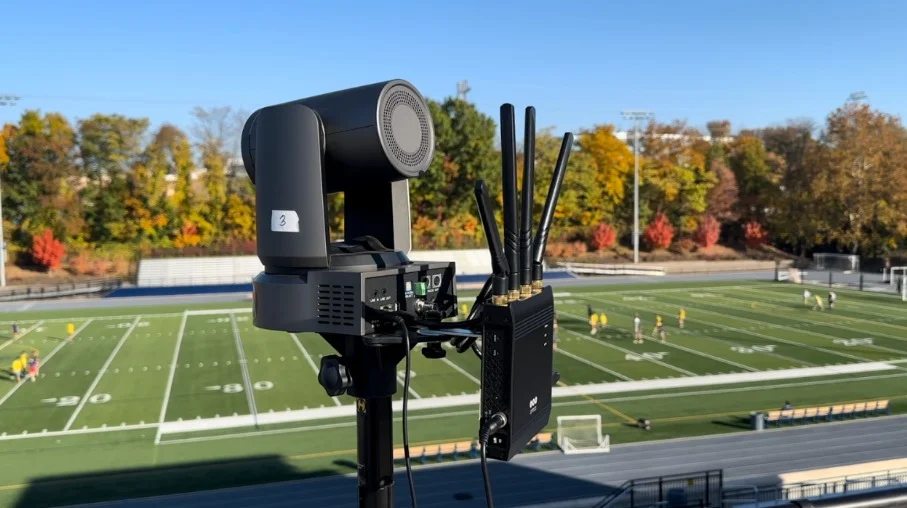
PTZ cameras have quickly become a staple in modern sports production due to their versatility, affordability, and remote control capabilities. Unlike traditional static cameras that require a dedicated operator for each unit, PTZ cameras can be managed from a central location, offering dynamic control over pan, tilt, and zoom functions with precision.
This makes PTZ cameras ideal for capturing fast-paced sports action. Whether you’re covering a football game with multiple moving parts or tracking a single athlete on a basketball court, PTZ cameras provide the flexibility to follow the action smoothly and seamlessly. In the past, achieving this level of control would have required expensive, manned camera setups. Now, with PTZ cameras, producers can achieve the same results with fewer operators, significantly reducing production costs.

Brands like PTZOptics have been at the forefront of this movement, offering high-quality PTZ cameras that are optimized for both professional and educational environments. With advanced features like NDI (Network Device Interface) integration, IP-based control, and 4K resolution, PTZOptics cameras are giving sports broadcasters powerful tools to deliver top-tier broadcasts without breaking the bank.
Remote Production: Breaking Down Barriers
Remote production, or REMI (Remote Integration Model), is transforming how sports are covered, particularly for smaller venues and organizations with limited budgets. In the traditional model, producing a live sports broadcast required extensive on-site equipment, a full production crew, and significant travel costs. With the rise of remote production, many of these logistical challenges have been eliminated.
Remote production allows video feeds from multiple cameras to be sent back to a central control room, often miles or even continents away from the venue. This means that a single production team can cover events happening in different locations without ever leaving their central office. By utilizing PTZ cameras that can be remotely controlled over a network, sports broadcasters can manage everything from camera angles to graphics overlays from a distance, saving both time and resources.

PTZOptics Hive is an example of a cloud-based platform designed to support remote production workflows. Hive allows operators to control multiple PTZ cameras remotely, adjust settings like exposure and color balance, and even perform tasks like remote camera switching—all from a single, centralized interface. The result is a streamlined production process that is both scalable and cost-effective, making high-quality sports broadcasts accessible to organizations of all sizes.
Salesianum School: A Case Study in High School Sports Production
A prime example of how PTZ cameras are revolutionizing high school sports production can be found at Salesianum School in Wilmington, Delaware. The school recently upgraded its sports production capabilities with a cutting-edge system featuring six PTZOptics cameras. This system allows the student production team to capture multi-angle, professional-quality broadcasts of their sporting events, bringing the excitement of high school sports to fans, alumni, and families who can’t attend in person.

The PTZ cameras are connected via PTZOptics’ wireless cables, enabling seamless control of multiple cameras from a single location. Using the SuperJoy joystick, student operators can manage all camera movements remotely, while the video feed is displayed on an HDMI monitor for real-time switching between shots. The integration of vMix allows for instant replays and dynamic overlays, further enhancing the viewing experience.
Salesianum’s system exemplifies how high schools can leverage PTZ cameras and remote production technology to engage their community. By streaming live games online, the school is able to reach a broader audience, including alumni and distant family members who might not be able to attend in person. With PTZOptics Hive, their remote production is scaled to cover multiple sports venues, from football fields to indoor gyms, all controlled from a single, centralized platform.
This forward-thinking approach is providing Salesianum’s students with valuable hands-on experience in live broadcasting while delivering professional-quality content that rivals that of major networks.

vMix and NDI: Enhancing Remote Workflows
At the heart of remote sports production is the integration of NDI, a technology that enables high-quality video streams to be shared across a network in real time. NDI allows video signals from PTZ cameras to be seamlessly integrated into production software like vMix, which offers an all-in-one solution for live streaming, instant replays, and video switching.
For sports broadcasters, vMix provides the ability to create professional, multi-camera productions with ease. Remote control of PTZ cameras via vMix means that even small production teams can manage complex broadcasts with minimal personnel. Instant replay features, graphics overlays, and remote video integration through tools like Zoom are just a few of the ways vMix is enhancing remote sports production.
The combination of vMix, NDI, and PTZ cameras creates a flexible and scalable solution that can grow with the needs of any sports organization. Whether it’s a local high school football game or a professional sports event, the ability to remotely manage and produce high-quality content is transforming the way sports are broadcasted.

Future Trends in Sports Production Technology
As we look to the future of sports production, several key trends are shaping the industry:
- Increased Use of AI and Automation: As remote production continues to evolve, artificial intelligence (AI) is expected to play a larger role in automating camera movements, shot selection, and even highlight creation. AI-powered PTZ cameras can track players automatically, reducing the need for manual camera operation and ensuring that the most important moments are always captured.
- Scalability and Cloud Integration: Cloud-based platforms like PTZOptics Hive are set to become even more integral to sports production. With cloud technology, production teams can scale up or down depending on the size of the event, offering flexibility for both large and small-scale sports productions. Cloud integration also allows for remote collaboration, where teams in different locations can work together in real time.
- Multi-Platform Streaming: As audiences continue to shift toward online platforms, multi-platform streaming will become more critical. Sports broadcasters will need to deliver content simultaneously to YouTube, Facebook, Twitch, and other platforms to meet the growing demand for digital content. PTZ cameras, with their ability to connect directly to streaming platforms via protocols like RTMP, are poised to play a key role in this multi-platform future.
- Virtual and Augmented Reality: Virtual reality (VR) and augmented reality (AR) are set to make waves in sports production, allowing viewers to experience games in new and immersive ways. PTZ cameras, paired with AR overlays, could provide real-time stats, player information, and enhanced visual elements to enrich the viewing experience.
Conclusion: The Future of Sports Broadcasting
As the sports production industry continues to evolve, PTZ cameras and remote production technology are at the forefront of this transformation. By offering flexibility, scalability, and cost-effectiveness, PTZ cameras are making professional sports broadcasts accessible to organizations of all sizes, while remote production workflows are breaking down the traditional barriers of live event coverage.
Companies like PTZOptics are leading the charge with innovative camera technology and cloud-based production platforms that simplify the process and reduce costs. As remote production and PTZ technology become more sophisticated, the future of sports broadcasting looks brighter than ever, with more opportunities for broadcasters to deliver high-quality, immersive experiences to audiences around the world.


